
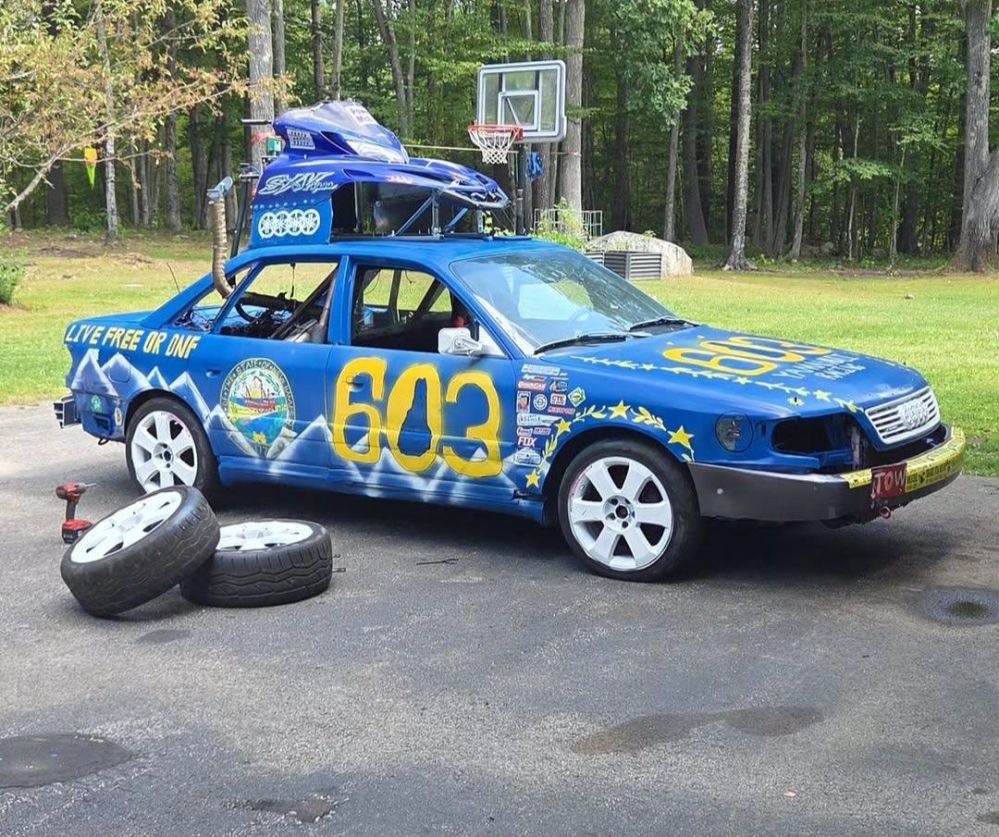
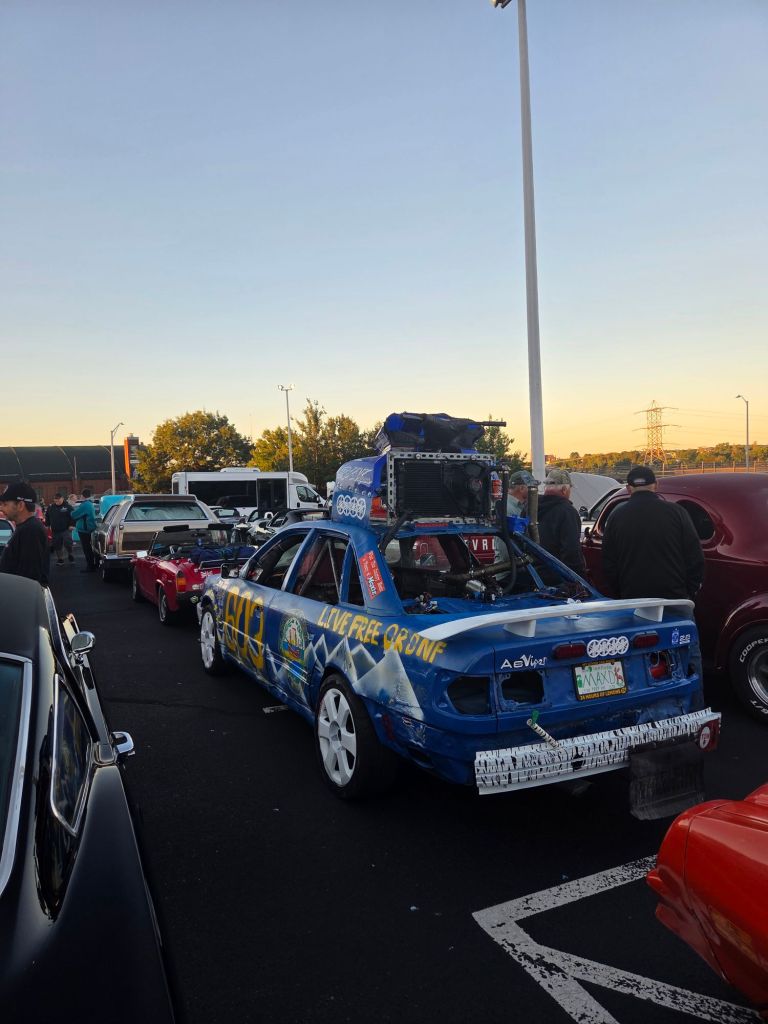
As I’ve written about before, I recently bought a 24 Hours of Lemons race car for $400. It was a pink 1996 Audi a6, with the 2.8 v6 up front and a snowmobile engine in the back. Over the summer, I’ve done lots of work and made plenty of improvements to the car. The most obvious ones, as you’ve likely seen from the cover image, are the car’s new blue livery and the snowmobile hood mounted to the roof. My first order of business over the summer was painting the car. I mocked up liveries in Forza until I found one I liked. My team and I decided that a New Hampshire theme would work well for the car. A state known for redneck engineering and snowmobiles? Perfect for the snowmobile-engined contraption that is the Yamahaudi. And, as was once said in a 24 Hours Of Lemons youtube video, while describing the Snouty Audi, “New Hampshire really is the Alabama of the North.” I decided on Krylon gloss patriotic blue, a decision that I entirely regret. I went through tons of sandpaper, plenty of primer, and about 12 cans of blue paint to get a proper basecoat. It was around this point that I found out that I should’ve bought a dedicated automotive paint, as the Krylon really wasn’t working that great for this application. And, to salt my wounds, we bought out all of our local stores of it, and became largely unable to find any more from a store a reasonable distance from my house. Alas, I had to turn to the internet.
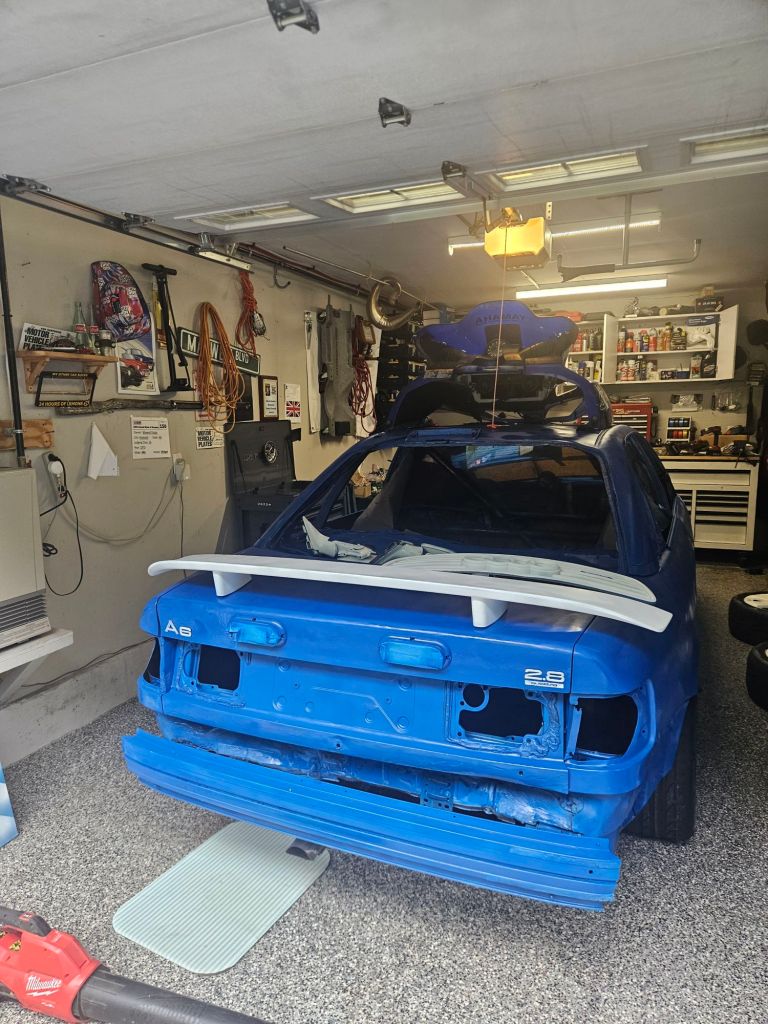
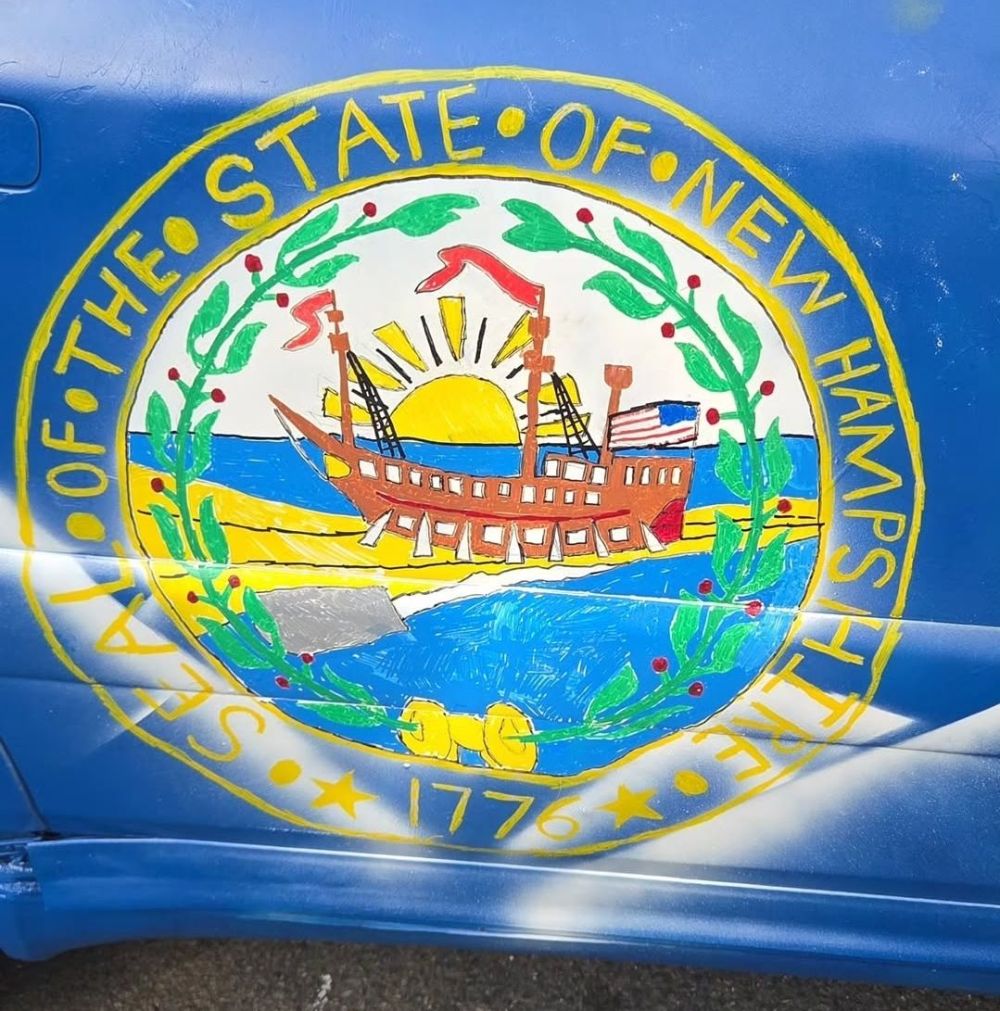
However, once the base coat was done, things could sail a bit smoother. I painted white mountains, representing NH’s white mountain range, on the side of the car with a rattle can and a cardboard template. It came out shockingly good for what it was. We signed up wicked early to secure the number 603, and painted it on both sides of the car with yet another cardboard template, albeit a bit more complex this time! I painted the NH state seal (the main feature of the state flag) on the rear door with posca markers, which, once again, came out way better than it had any right to. One thing that kind of shocked me was how kindly the oil-based posca markers took to clear coat. No bleeding or issues whatsoever.
Our team name is “Live Free or DNF,” a play around New Hampshire’s state motto, Live Free Or Die, with, as I’m sure you know, DNF standing for “Did Not Finish” in racing terms. I’ve also plastered the front fender in “sponsor” stickers, in true NASCAR style. From Summit Racing to the Garbage Pail Kids, we’ve got it all. I’ve also put my custom Yamahaudi logo on it several times, with custom 3d-printed badges on the trunklid and front grille, as well as being painted on some of the supports for the roof mounted snowmobile cowl. As for that cowl, it is attached to the roof via a frame made of unistrut, threaded rod, and bent black iron gas pipe. It’s remarkably sturdy up there, and for good reason. The cowl provides a little bit of protection for the snowmobile engine’s radiator, which is mounted on the rear of the roof, and incorporated into the frame holding the snowmobile cowl. And, yes, the lights on the snowmobile cowl work!

That brings me quite nicely to the mechanical work I’ve done. My father sourced and rebuilt a 2002 Yamaha SXViper engine. It was a thorough rebuild because the engine was fairly trashed, with barely any compression on one cylinder, and less-than-optimal on the other two. One thing that we didn’t notice is that the snowmobile we purchased had no electric start. While the idea of pull-starting a car all weekend did sound utterly hilarious, we thought better of it, and added electric start (an astonishingly easy conversion if you’ve got the parts).

Once the engine was fitted, we were able to start improving the systems around it. Our biggest issue with the snowmobile engine was that in past years, it had heated the engine’s middle cylinder to unbelievable temperatures, melting it and causing the engine to throw a rod through the block simultaneously. We’re looking to avoid that, so most of our improvements are attempts to keep the engine cooled. The most noticeable one is the aforementioned roof-mounted radiator. The old cooling setup consisted of house baseboard radiator pipe on the roof, and a small motorcycle radiator in the trunk. This was clearly not adequate. The motorcycle radiator didn’t get nearly enough airflow, and the baseboard radiator simply did not have the cooling ability to warrant keeping it. So a replacement was certainly in order. A retired Saab mechanic traded me a stack of radiators for the carburetors off of the old, blown up sled engine. The radiator we used is from a 900 turbo. So, not only did we upgrade to a car radiator in an area with much more airflow, we also used a radiator from a Swedish performance machine! Pumping to a roof-mounted radiator is a lot of work for a little snowmobile pump, so we added a Davies Craig booster pump into the system, and thus far it seems to be working wonders for the sled engine.
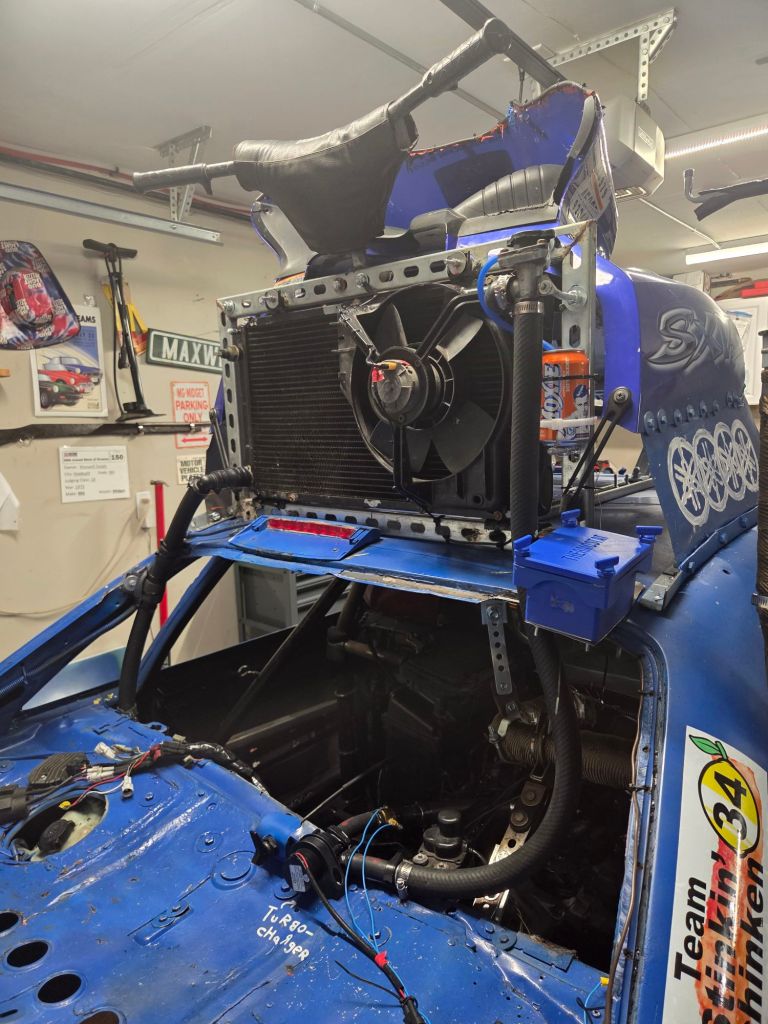
Another mod we made to try and keep the rear engine bay cooler was a redirection of the exhaust. The old setup had the exhaust pipe running all the way across the car. We added a 180 degree bend and put it out of the rear quarter window, and even heat wrapped it. This way, the exhaust is adding a lot less temperature to the engine bay, keeping the air temps down, allowing the sled to run cooler. We’ve also put on a tractor flap for the vertical exhaust. This is totally, 100% purely to keep the rain out. It is NOT there just because I think it looks cool. Totally. Our next modification for the snowmobile exhaust is going to have to be a cherry bomb, as it’s way too loud with no muffler and just the stock expansion chamber.

Aside from new seatbelts, a repair to the race seat that involved my mom’s sewing kit and some fishing line, and general maintenance, there haven’t been many other dramatic changes to the car. We’re on track to be ready to race for Loudon’s Halloween Hooptiefest in October, with both engines! Anyone else who races us will certainly know us by the sound/smell of the 2 stroke engine. I hope to see some of you there, and thanks for reading!

 Slow Traffic Keep Right
Leave a comment